
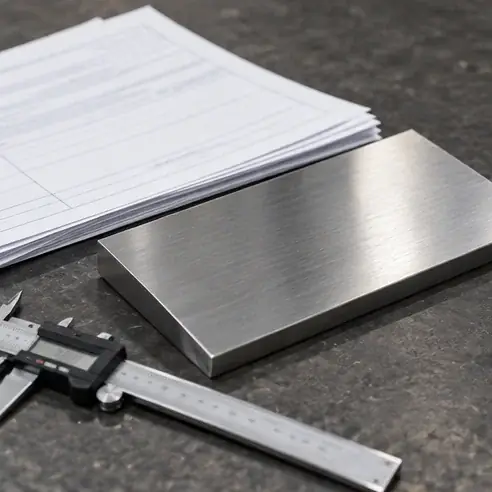
A mill test certificate, commonly called an MTC or MTR, connects a particular material batch to its stated specification and test results. For stainless steel buyers, reading the certificate is part of checking that the delivered stock is what was ordered. A certificate is valuable only when its identity matches the actual material.
What EN 10204 3.1 means
EN 10204 defines types of inspection documents. A type 3.1 certificate is issued by the manufacturer and validated by its authorized inspection representative who is independent of the manufacturing department. It includes results of specific inspection on the products supplied or on a defined test unit. It is not the same as an independent third-party 3.2 certificate. If your project specifies 3.2 or witness testing, arrange that before the material is processed or dispatched.
Check the issuing manufacturer's name, document number, date, signature or validation, purchase order reference and product description. A scan with a grade name but no link to the delivered batch is not enough for traceability. Ask for clarification rather than editing or accepting a mismatched certificate.
Start with the heat number
The heat, cast or melt number identifies a batch of steel made from a particular melt. Find that number on the MTC and on the material marking, tag or package. For a cut sheet or plate, ask how the original heat identity has been transferred to the smaller pieces. Different mills and processors use slightly different labels; the point is to maintain a verifiable chain from mill to your shipment.
Also compare dimensions, weight or quantity, product form, standard and grade. If your purchase order says ASTM A240 S31603 sheet with 2B finish, a certificate for S30400 plate or for a different heat does not substantiate that supply. A supplier may send several certificates if the order contains more than one heat; check each group separately.
Read the chemistry
Look for a chemical composition table with measured values, often reported as percentages by mass. Common stainless steel elements include carbon, chromium, nickel, molybdenum, manganese, silicon, phosphorus, sulfur and nitrogen. Compare the measured values to the specified grade's applicable standard and revision, not to an unrelated web table of "typical" chemistry.
For instance, the presence of molybdenum is one useful clue in distinguishing 316 from 304, but a quick glance at one element is not a complete grade check. Low-carbon variants require particular attention to carbon. The MTC should identify the grade or grades it certifies; do not infer dual certification from a single measured carbon result alone.
Read the mechanical tests
A mechanical section usually lists tensile strength, 0.2% proof or yield strength and elongation. Units matter: megapascals and ksi are both common, and elongation depends on the specified gauge length. Confirm that the measured results meet the applicable standard for the product and condition. An unusually high number is not automatically better: the application may require formability, toughness or a particular processing condition.
Some orders require hardness, impact tests, corrosion tests, ferrite content, ultrasonic testing or positive material identification. If a test is absent, it was not necessarily performed. Define extra requirements on the order and request supporting results. Do not mistake an MTC for a blanket fitness-for-service approval.
A simple receiving check
Keep the purchase order, certificate and receiving record together. Match supplier, product, standard, UNS grade, finish, dimensions, heat number and quantity. Compare chemistry and mechanical results with the specification. Check markings and look for transport damage. If something does not match, segregate the batch and ask the supplier for a corrected explanation or replacement before using it.
For critical service, an engineer or quality specialist should review the document and may call for independent verification. The MTC helps establish what was made and tested; whether it is suitable for your process is a separate design question.
Explore our product range or Contact us.
Source and scope
EN 10204 document types: consult BS EN 10204:2004 inspection document types and your project specification. This guide is not an inspection certificate.